Rust Solo Survival Through Blooprint's Apex Journey
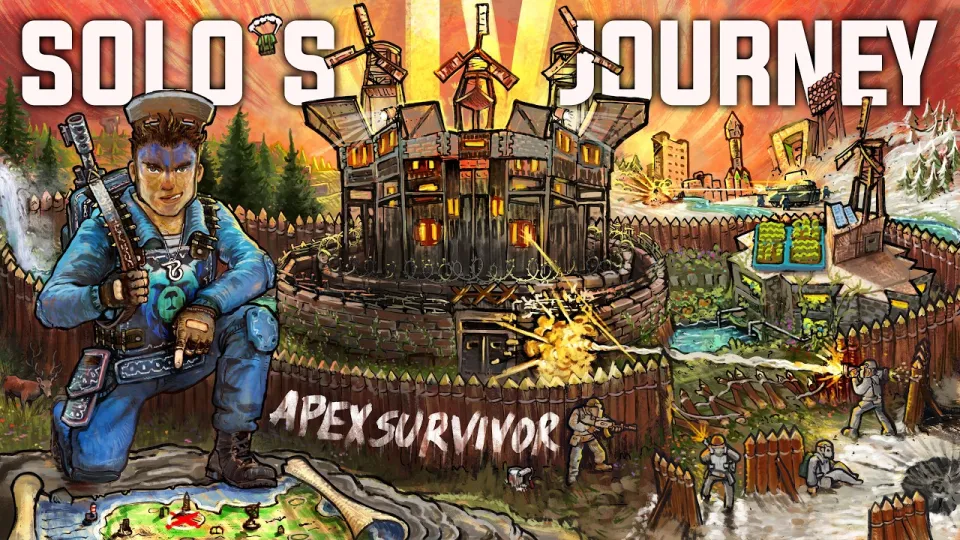
Video: Rust - A Solo's Journey IV: Apex Survivor (Movie)
You can order the same kind of articles for your own video to boost it on YouTube and Google. Just message the Telegram bot @sat_sit_bot. It writes articles around your video, embeds the video and publishes them on popular niche websites (no ads). Your first 50 articles are free.
· based on the channel Blooprint
Rust is a survival game where a solo player starts naked on a beach with a rock and must build, defend and raid alone on a server full of clans — and Blooprint's "A Solo's Journey IV: Apex Survivor" is a full demonstration of what that grind looks like across 14 days. The movie compresses a long solo wipe into a structured story, and viewers can follow the exact progress with the Solo's Journey tracker, a site built specifically for this video where you enter your timestamp and see the player's status at that moment.
What the Rust solo run actually covers
The core of the project is a 14-day solo survival attempt on a live Rust server, filmed and edited into a single movie of just under five hours. The chapter list runs from an introduction through twelve numbered chapters to a finale, and the pacing moves from early base placement and farming toward PvP, raids and revenge arcs. For anyone who has played Rust solo, the appeal is recognition: no clan to cover your back, no one to split sulfur with, and every decision about where to build carries the risk of waking up to a raided base.
A few concrete details frame the scale of the project:
- 14 days of solo play on one wipe cycle.
- 300+ hours of filming and editing, per the video description.
- A runtime of roughly 4 hours 47 minutes, split into 12 chapters.
- A companion tracker website for timestamp-based progress checks.
- A 2.5 million subscriber milestone tied to the release, with limited merch drops.
Base building and farming as a solo player
Solo Rust base design is a compromise between cost, footprint and raid resistance, and the run leans into farm bases and unconventional cores rather than meta clan layouts. A solo player cannot afford a massive compound, so the practical approach is a compact, layered base placed near monuments for efficient recycling and quick loot runs — but far enough from high-traffic roads to avoid constant attention. Farming becomes a routine: nodes, barrels, scrap runs to Outpost or Bandit Camp, and recycling trips timed to avoid ambushes.
Key solo priorities that show up in long-form runs like this:
- Starter base first, upgrades later. Get a tool cupboard, doors and a sleeping bag down before chasing gear.
- Spread your loot. Splitting valuables between stashes, secondary bases and your main core limits the damage of a single raid.
- Farm with purpose. Sulfur and metal are the real currency of a wipe; scrap buys blueprints and workbench access.
- Keep a backup kit. A hidden bag with armor and a weapon turns a death into a setback instead of a reset.
PvP, raids and the revenge storyline
What separates a five-hour Rust movie from a highlight reel is narrative, and the run builds one around rivalries, alliances and payback. Solo PvP in Rust is asymmetric: you pick fights near monuments, third-party other players' raids, or defend your own base against groups. The chapters covering raids and revenge are where the tension peaks, because a failed raid as a solo means losing hours of farming with no clan to reimburse you.
Practical takeaways from that style of play:
- Scout before you commit — count doors, check for turrets, watch traffic around the target base.
- Raid when the server is quiet, not during peak hours when counter-raiders are online.
- Bring exactly what the raid needs; excess explosives are loot for whoever counters you.
- Have an escape route and a stash nearby for the loot you pull out.
Monuments, oil rig and cargo ship routes
Monuments are the solo player's economy, and the big set-piece locations — Oil Rig and Cargo Ship — are where risk and reward scale fastest. Oil Rig requires keycards and heavy resistance from scientists, but it pays out in military crates and components that accelerate a wipe dramatically. Cargo Ship is a moving target: it appears on a timer, it is contested almost immediately, and boarding it solo means fighting both NPCs and other players for the same crates.
A workable solo route looks like this:
- Green and blue cards first. Build a keycard chain from low-tier monuments before attempting Oil Rig.
- Time your runs. Go for Cargo Ship right as it spawns or late in the cycle when most players are busy elsewhere.
- Bring a boat and a fallback. Park where you can leave fast, and never board with your entire kit if you can avoid it.
- Extract, don't linger. Loot, get to safety, sort it out at base — the crates are worthless if you die on the deck.
Why viewers treat a five-hour Rust video as normal
Long-form Rust content has its own audience, and the reaction to this release shows it: a runtime near five hours is treated as a feature, not a barrier. Viewers describe watching it across multiple sittings, treating it like a series rather than a single video, and the chapter structure supports that — each chapter is a self-contained arc with its own goals. The tracker website reinforces the format by letting people check progress at any timestamp, which turns a long movie into something closer to an interactive log.
The comparison viewers keep making is about versatility: chill base-building content, storytelling, high-level PvP and cinematic editing usually live on different channels, and this project tries to deliver all of them in one run. That is also why the milestone framing matters — the video doubles as a thank-you for 2.5 million subscribers, with limited merchandise tied to the release.
Common questions about solo Rust runs
Newer players watching long solo runs tend to ask the same things, and the answers are practical rather than mysterious. Solo Rust is not about winning a wipe; it is about surviving it with enough left over to keep playing.
- How do you avoid getting raided as a solo? You don't fully. You reduce the payoff: smaller bases, spread loot, no obvious compound, and offline-friendly designs.
- Is Oil Rig worth it solo? Yes, if you have keycards, a plan and an exit. It is the fastest route to military loot, and also the fastest way to lose a kit.
- How do you handle groups? Avoid open fights, use terrain and monuments, and pick moments when a group is distracted by its own raid.
- How long does a solo wipe take to feel established? Usually a few days of focused farming, depending on server pop and how often you die.
Useful links
- Solo's Journey tracker — enter a timestamp and see progress during the run.
- Blooprint Youtooz vinyl figure — limited release tied to the 2.5M milestone.
- Epic Desk mousepads and playmats — Solo's Journey desk gear.
- Hires Studio — animated intro work.
- Veys — thumbnail artist.
Final thoughts on Apex Survivor
Apex Survivor works because it treats solo Rust as a story with stakes rather than a montage of kills: 14 days, one player, and a base that has to survive everything the server throws at it. The 300+ hours of production behind a sub-five-hour movie explain why the pacing holds up across chapters, and the tracker site gives viewers a reason to engage beyond passive watching. Channel Blooprint built this as both an anniversary project and a demonstration of what solo play can look like at a high level. If you want to follow along properly, open the Solo's Journey tracker and check the run chapter by chapter.
Key takeaways
- Blooprint survived 14 days of solo Rust and turned the run into a movie just under five hours long (4:47:05 runtime listed in the chapters).
- The edit and filming took over 300 hours according to the video description, with a dedicated tracker site for timestamps.
- The movie is split into 12 chapters plus an intro and finale, from base building to late-wipe raids.
- The release doubles as a 2.5M subscriber milestone, with limited Youtooz figure and Epic Desk mousepad drops.
- Solo Rust means no clan backup: every farm run, raid and defense is handled by one player.
Source: Rust - A Solo's Journey IV: Apex Survivor (Movie) · Markdown version
Questions & answers
How long is Blooprint's Apex Survivor movie and how is it structured?
The movie runs just under five hours and is divided into an introduction, twelve numbered chapters and a finale. Each chapter covers a distinct phase of the 14-day solo run, so it can be watched in several sittings without losing the thread.
What is the Solo's Journey tracker website for?
It is a companion site built for this video. You enter your current timestamp and it shows the player's progress at that point in the run, which is useful when watching a long movie in multiple parts.
Is solo Rust actually viable on a populated server?
Yes, but it plays differently from clan Rust. Solo players rely on compact layered bases, distributed loot, timed farm runs and careful monument routes like Oil Rig and Cargo Ship, and they accept that losing a base is part of the wipe rather than a failure.
Why do viewers accept a five-hour Rust video?
Long-form Rust content has an established audience that treats it like a series. The chapter structure, storytelling and cinematic editing make the runtime feel intentional, and many viewers watch across several days rather than in one sitting.