How to follow VALORANT Champions Shanghai group stage like a pro analyst
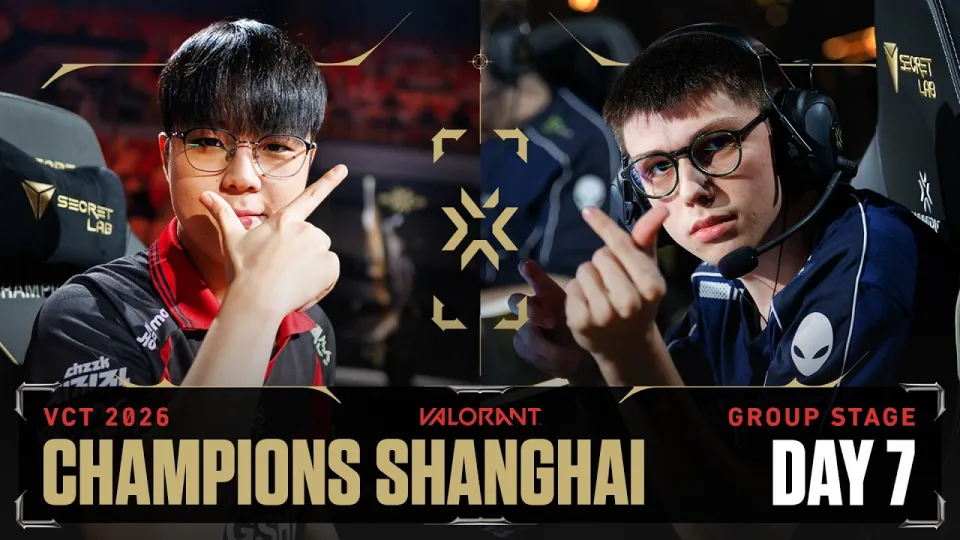
Video: VALORANT Champions Shanghai — Group Stage — Day 7
You can order the same kind of articles for your own video to boost it on YouTube and Google. Just message the Telegram bot @sat_sit_bot. It writes articles around your video, embeds the video and publishes them on popular niche websites (no ads). Your first 50 articles are free.
· based on the channel VALORANT Champions Tour
VALORANT Champions Shanghai is the 2026 world championship, and the group stage is where 16 teams from Americas, CN, EMEA and Pacific fight for a playoff spot before the September 24 to October 18 event crowns a champion. To follow it properly, you need to know the format, the storylines and the places where the broadcast actually happens — starting with the official esports account at VALORANT Esports on X, which posts schedules, results and bracket updates in real time.
Day 7 of the group stage, published on the VALORANT Champions Tour channel, is a full-length VOD of one broadcast day: draft, pistol rounds, mid-round calls and post-match desk segments. It is not a highlight reel, so treat it as primary material — the kind of footage analysts scrub through to check setup defaults, utility usage and economy discipline.
What the VALORANT Champions Shanghai group stage actually is
The group stage is the first phase of the world championship, where sixteen qualified teams are split into groups and play a round-robin or double-elimination style bracket to decide who advances. The official event description is explicit: sixteen teams from the Americas, CN, EMEA and Pacific compete to become the 2026 VALORANT World Champion, and the tournament window runs from September 24 to October 18.
Three things define this stage more than any single match:
- Regional depth. Four regions send representatives, and the seeding is not equal — some regions arrive with more slots and more proven international form.
- Short series. Group play rewards preparation over adaptation. Teams that bring two or three clean defaults and one surprise map tend to survive.
- Compressed schedule. With a fixed number of broadcast days, a single loss changes the map veto math for everyone else in the group.
Day 7 sits deep enough into the phase that teams already know their playoff scenarios. That makes the VOD useful: you can watch decisions being made under known pressure rather than in a vacuum.
How to watch a full broadcast day without losing the thread
Watching a multi-hour group stage VOD is a skill, and the fastest way to learn it is to stop watching linearly. The broadcast is long, includes desk analysis, replays and pauses, and the match action is not evenly distributed.
Use this order:
- Read the scoreline first. Check the final map scores before pressing play, so you know which maps were close and which were one-sided.
- Watch pistol rounds and the first gun round of each half. These set the economy tone for everything after.
- Skip to the second half of any map that went to double digits. That is where set plays break down and individual reads matter.
- Watch the post-match interview and desk segment. They usually name the exact adjustment that flipped the series.
- Note the tech pauses. They are not filler — they often mark a moment where a team lost tempo.
That last point matters for Day 7 specifically. Chat reaction to the broadcast centered heavily on an endless series of technical pauses, with viewers asking why there were so many. If you are studying the VOD, treat each pause as a bookmark: the round before it and the round after it frequently show a momentum shift.
The 2026 context that makes Shanghai different
The 2026 season is the one where the hierarchy cracked. The event description frames it plainly: twice at Masters, a new champion has risen, and the era of a single dominant favorite has been challenged by a fearless generation of challengers.
That has two practical consequences for how you read the group stage:
- Masters form does not transfer automatically. Winning a Masters event proves a team can peak across one bracket. A world championship asks for a longer peak against more prepared opponents.
- Regional seeding is misleading. A team that looked dominant domestically can arrive in Shanghai with a thinner map pool than a fourth seed from a deeper region.
This is exactly the argument viewers made in the comments: that stronger teams in some regions missed the event entirely while all CN representatives qualified. Whether or not you agree, it is the right question to ask — and the group stage is where it gets answered on the server rather than on paper.
Reading the CN debate without the noise
Chinese representatives entered the group stage under the heaviest scrutiny of any region, and the broadcast chat reflected it. The recurring criticism was specific rather than generic: lost eco rounds, dropped 5v2 retakes, and utility usage that looked improvised once set strategies were disrupted.
Strip out the frustration and three testable claims remain:
- Economy discipline. Losing to a save or a half-buy is the single most costly mistake in a short series, because it hands the opponent a free round plus a rifle advantage.
- Man-advantage conversion. A 5v2 should be close to automatic. When it is not, the problem is usually communication about who holds which angle after the plant or the trade.
- Utility creativity. Defaults win the first four rounds. After that, teams need improvised utility — a recon dart used to bait rather than to find, a smoke placed to split a site rather than to block it.
A viewer also flagged a specific moment where a Yoru clone looked, for a split second, like it was helping hold a site. That kind of confusion is diagnostic: when a team's utility reads are unclear to the audience, they are often unclear to each other too.
Where the broadcast and community actually live
The official channels are the only reliable source for schedule changes during a live event, especially when tech pauses push the day's timing. The VALORANT Champions Tour posts the full VOD library on YouTube, while live matches and co-streams run on Twitch at https://www.twitch.tv/valorant.
For everything else:
- Schedule and results announcements: https://x.com/valorantesports
- Community discussion and clips: https://www.facebook.com/ValorantEsports/ and https://www.instagram.com/valorantesports/
- Short-form highlights: https://www.tiktok.com/@valorantesports
- Written news and previews: https://www.valorantesports.com/news
If you only follow one, follow the X account. Group stage days shift, and the account is where a delayed start or a moved match appears first.
Common questions from the group stage broadcast
Viewers arriving at a full-day VOD usually ask the same handful of things, and the answers are mostly about format rather than opinion.
Why so many technical pauses? Live events run on shared hardware and network infrastructure, and a single issue can trigger a chain of checks. Pauses cluster on days with back-to-back series and long broadcast blocks, which is exactly what a late group stage day looks like.
Why does the chat complain about regions rather than teams? Because slot allocation is the visible part of the system. When a region gets several representatives and they struggle, the argument moves from player performance to qualification structure.
Is a group stage loss fatal? Usually not, but it changes the map veto. Teams that lose early often burn their surprise pick in the next series and arrive in the playoffs with a narrower pool.
Can you learn from a VOD without pro-level aim? Yes — economy decisions, default setups and post-plant positioning transfer to ranked play far more reliably than flick mechanics do.
The takeaway
The VALORANT Champions Shanghai group stage is best read as a stress test rather than a formality: sixteen teams, four regions and a 2026 season in which two different Masters champions proved that no roster owns the year. Day 7 of the broadcast is worth a full watch if you care about economy discipline and mid-round adaptation, and worth a targeted watch if you only want the moments where set plays collapsed. Use the tech pauses as bookmarks, use the desk segments for the adjustment, and check the official VALORANT Esports account on X before you sit down — schedules move. The full-day VOD comes from the VALORANT Champions Tour channel, which is the cleanest place to study how top teams actually play when the bracket is on the line.
Key takeaways
- VALORANT Champions Shanghai runs September 24 to October 18, with 16 teams from Americas, CN, EMEA and Pacific.
- Group Stage Day 7 is the seventh broadcast day of the opening phase, streamed by the VALORANT Champions Tour channel.
- Two different teams won Masters events in 2026, so Shanghai is the first true tiebreaker of the season.
- Viewers flagged a string of technical pauses on Day 7, a recurring talking point in the chat.
- CN representatives drew heavy criticism for losing eco rounds and 5v2 situations in group play.
Source: VALORANT Champions Shanghai — Group Stage — Day 7 · Markdown version
Questions & answers
How many teams play in the VALORANT Champions Shanghai group stage?
Sixteen teams qualify, drawn from the Americas, CN, EMEA and Pacific regions. They compete across the tournament window from September 24 to October 18 to become the 2026 VALORANT World Champion.
Why were there so many technical pauses during the Day 7 broadcast?
Long broadcast days with back-to-back series put pressure on shared event hardware and network infrastructure, and a single fault can trigger a chain of checks. Pauses tend to cluster on packed group stage days, which is why viewers noticed so many of them.
Is it worth watching a full group stage VOD instead of highlights?
Yes, if you want to learn rather than just see frags. Highlights cut out the economy decisions, default setups and post-plant positioning that actually transfer to ranked play, while a full VOD shows the reasoning behind each round.
Where can I follow the VALORANT Champions Shanghai schedule and results?
The official VALORANT Esports account on X posts schedules, results and bracket updates first, and the VALORANT Champions Tour YouTube channel hosts the full VOD library. Live matches also stream on Twitch at twitch.tv/valorant.